

 United Kingdom
 France
 Germany
 Netherlands
 Sweden
 USA
USA
 Italy
Italy
 Spain
Spain

More From Contributor



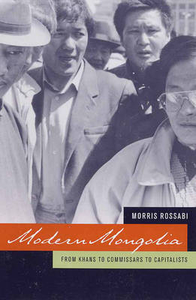
Modern Mongolia
Land-locked between its giant neighbors, Russia and China, Mongolia was the first Asian country to adopt communism and the first to abandon it. When the Soviet Union collapsed in the early 1990s, Mongolia turned to international financial agencies - including the International Monetary Fund, the World Bank, and the Asian Development Bank - for help in compensating for the economic changes caused by disruptions in the communist world. ”Modern Mongolia” is the best-informed and most thorough account to date of the political economy of Mongolia during the past decade. In it, Morris Rossabi explores the effects of the withdrawal of Soviet assistance, the role of international financial agencies in supporting a pure market economy, and the ways that new policies have led to greater
political freedom but also to unemployment, poverty, increasingly inequitable distribution of income, and deterioration in the education, health, and well-being of Mongolian society. Rossabi demonstrates that the agencies providing grants and loans insisted on Mongolia`s adherence to a set of policies that did not generally take into account the country`s unique heritage and society.Though the sale of state assets, minimalist government, liberalization of trade and prices, a balanced budget, and austerity were supposed to yield marked economic growth, Mongolia - the world`s fifth-largest per capita recipient of foreign aid - did not recover as expected. As he details this painful transition from a collective to a capitalist economy, Rossabi also analyzes the cultural effects of
the sudden opening of Mongolia to democracy. He looks at the broader implications of Mongolia`s international situation and considers its future, particularly in relation to China.
political freedom but also to unemployment, poverty, increasingly inequitable distribution of income, and deterioration in the education, health, and well-being of Mongolian society. Rossabi demonstrates that the agencies providing grants and loans insisted on Mongolia`s adherence to a set of policies that did not generally take into account the country`s unique heritage and society.Though the sale of state assets, minimalist government, liberalization of trade and prices, a balanced budget, and austerity were supposed to yield marked economic growth, Mongolia - the world`s fifth-largest per capita recipient of foreign aid - did not recover as expected. As he details this painful transition from a collective to a capitalist economy, Rossabi also analyzes the cultural effects of
the sudden opening of Mongolia to democracy. He looks at the broader implications of Mongolia`s international situation and considers its future, particularly in relation to China.

Product Description
Reviews/Comments
Add New
Vouchers
No voucher codes found.
Do you know a voucher code for this product or supplier? Add it to Insights for others to use.
Do you know a voucher code for this product or supplier? Add it to Insights for others to use.
 Denmark